Saturday, August 6, 2016

Looking for Alaska by John Green


Bibliographic Information
Publisher: Dutton Juvenile
Publication year: 2005
ISBN: 978-0142402511

Reader’s Annotation
Miles chooses boarding school for his junior year in order to seek “The Great Perhaps” and have an adventure for the first time in his life. His experiences at Culver Creek introduce him to new friends, epic pranks, strawberry wine, and an event that will change him forever.

Plot Summary
Miles is an eleventh grader with no real friends, fascinated by famous last words. He chooses to attend Culver Creek Boarding School for his junior year because he wants to seek what French poet Francois Rabelais called “The Great Perhaps.” Miles’ roommate, sarcastic southerner The Colonel, quickly nicknames Miles “Pudge” and welcomes him into life at Culver Creek. Sneaking cigarettes, booze, and girls into your room are all in a day’s work, not to mention pranking the entitled rich students who only stay on campus during the week. But for Miles, nothing is more exciting than meeting Alaska Young. She is gorgeous, witty, well-read, and Miles quickly identifies her as his dream girl. The only problem, Alaska is madly in love with her boyfriend who goes to another school. The group of friends spend the first semester engaging in silly shenanigans, until one night of drinking ends in tragedy and Pudge and The Colonel are compelled to spend the rest of the school year figuring out what went wrong.

Critical Evaluation
A striking device Green uses in the structure of Looking for Alaska is the headings of the number of days “before” and “after” at the beginning of each chapter with no explanation of the main event. As soon as the switch from before to after happens the reader understands exactly why they were there, but the first half of the book is shrouded in mystery. The reader knows something monumental is going to happen as the countdown dwindles, but is left in suspense until the transition. There is rarely such blatant attention brought to the buildup, main conflict, and aftermath of a story. The device represents how Miles sees his time at Culver Creek Boarding School: as revolving completely around Alaska. Even after she dies, he is only counting the days since and investigating exactly what happened. For this reason, Looking for Alaska stays with the reader long after the book is closed.

Author Information
John Green is the New York Times bestselling author of Looking for Alaska, An Abundance of Katherines, Paper Towns, and The Fault in Our Stars. He is also the coauthor, with David Levithan, of Will Grayson, Will Grayson. He was 2006 recipient of the Michael L. Printz Award, a 2009 Edgar Award winner, and has twice been a finalist for the Los Angeles Times Book Prize. Green’s books have been published in more than a dozen languages.

In 2007, Green and his brother Hank ceased textual communication and began to talk primarily through videoblogs posted to YouTube. The videos spawned a community of people called nerdfighters who fight for intellectualism and to decrease the overall worldwide level of suck. (Decreasing suck takes many forms: Nerdfighters have raised hundreds of thousands of dollars to fight poverty in the developing world; they also planted thousands of trees around the world in May of 2010 to celebrate Hank’s 30th birthday.) Although they have long since resumed textual communication, John and Hank continue to upload two videos a week to their YouTube channel, vlogbrothers. Their videos have been viewed more than 500 million times, and their channel is one of the most popular in the history of online video. He is also an active Twitter user with more than 3.8 million followers.

Green’s book reviews have appeared in The New York Times Book Review and Booklist, a wonderful book review journal where he worked as a publishing assistant and production editor while writing Looking for Alaska. Green grew up in Orlando, Florida before attending Indian Springs School and then Kenyon College.

Source: http://johngreenbooks.com/bio-contact/

Genre
Fiction

Curriculum Ties
Health
Philosophy

Booktalking Ideas
Introduce the character of Miles and the setting of Culver Creek Boarding School. Read the passage when Miles meets Alaska for the first time. Then give a rating from 1-5 and tell the audience why this is my rating, and take questions.

Reading Level/Interest Age
Booklist: Grades 9-12
School Library Journal: Grade 9 and up

Challenging Issues
Death of a Loved One
Language
Sexual Content and/or Nudity

Preparing for Potential Challenges
http://jeselynsminiyacollection.blogspot.com/p/preparing-for-potential-challenges.html

Why the Item Was Chosen
Looking for Alaska was published when I was about Miles’ age, and also searching for the Great Perhaps. Instead of moving to another state alone to attend boarding school I read Green’s debut novel three times in a row. Even at fifteen, I immediately recognized this book as an important part of the young adult genre. A few years later Green came to national fame with The Fault in Our Stars and Looking for Alaska was recognized as well. Although his other works have been made into movies and shouted from the rooftops by his army of Nerdfighters, I still feel Looking for Alaska is his most introspective, heartbreaking, and riveting novel. I included this book in my collection because the name John Green will draw young adults in, but the story itself will change their lives.

The Lovely Bones by Alice Sebold


Bibliographic Information
Publisher: Little, Brown and Company
Publication year: 2002
ISBN: 978-0316166683

Reader’s Annotation
Murdered by her neighbor at age fourteen, Susie watches from her own personal heaven as her family grieves her loss. Even though she has passed on, Susie does her best to send clues about her murderer to any living person who will listen.

Plot Summary
Susie Salmon is a carefree fourteen-year-old growing up in 1973 Pennsylvania with her loving and supportive parents, younger brother, and older sister. She loves to take pictures and dreams of being a nature photographer. One night George Harvey, a single adult male who lives in her neighborhood, lures Susie into an underground shelter he has constructed under the guise of wanting to show her a clubhouse where she and her friends can play. In the shelter he rapes and murders Susie, then disposes of her dismembered body parts in a safe that he later deposits in a sinkhole outside of town. Her soul is violently ripped from her body and catapulted skyward, where she finds herself in a personal heaven of her own design. After Susie gets more used to being dead, she discovers she can watch her family and friends on Earth. She also finds out that she is not the only person Harvey has killed; he is a serial murderer with female victims of all ages. When Susie realizes her old classmate Ruth is able to sense her presence, she sees an opportunity to aid in the investigation of Harvey and maybe find justice for herself and the other girls and women he murdered.

Critical Evaluation
Although The Lovely Bones borders on being a fantasy novel, Susie’s voice and point of view are incredibly realistic. Sebold’s descriptions of Susie’s school crush, to the attack ending in her own murder, to her own personal heaven could have been written by a fourteen-year-old growing up in the 1970’s. Possibly the most important writing decision Sebold makes in The Lovely Bones is beginning the novel in 1973 instead of present day. Unlike the early 2000’s when the book was published, the molestation and murder of children was hardly acknowledged in previous decades. Crime existed, but people chose to believe it didn’t happen in their own community, especially in middle class, midwest neighborhoods like the one in which the Salmon family lives. This opinion of child disappearance makes it more difficult for Susie to find justice for herself from heaven, but makes for an achingly riveting story as Susie watches her attacker continue to live his life after taking hers away.

Author Information
Alice Sebold is an American writer and bestselling author of the book The Lovely Bones, hailed as the most successful debut novel since Gone With the Wind.

Synopsis
Alice Sebold was born on September 6, 1963, in Madison, Wisconsin. Sebold was brutally raped while a college undergraduate. Her account of the incident became the subject of her memoir, Lucky. Sebold's first novel, The Lovely Bones, debuted in 2002, and proved to be a commercial and critical success. The author's second novel, The Almost Moon, was published in 2007.

Early Years
Born Alice Sebold on September 6, 1963, in Madison, Wisconsin. The daughter of two academic parents, Sebold grew up in a household dominated by dysfunction. Her mother, Jane, was an alcoholic, who suffered severe bouts of panic and anxiety, often leaving Sebold and her older sister Mary to take care of her.

Sebold's father, a Spanish professor, eventually relocated his family to Paoli, Pennsylvania, where Jane worked as a journalist for a small newspaper and he taught at the University of Pennsylvania. To help diffuse the difficulties her home life introduced, the argumentative and sarcastic Sebold took on the role of the "family moron."

"[They] seemed to have more fun, more freedom, and more personality," Sebold has said.

Tragedy Strikes
After high school, Sebold, in an attempt to distance herself from her family, enrolled at Syracuse University in upstate New York in the fall of 1980. But during her first year at the school, Sebold suffered a horrific event that would change her life. While walking back to her dorm one evening, she was brutally attacked and raped in a tunnel. Sebold eventually made it back to her room where friends took her to the hospital. After reporting her case to the police, one of the officers said she was "lucky" to be alive. Not long before, another rape had occurred in the same tunnel where Sebold had been attacked, that had resulted in a woman's death and dismemberment.

Sebold's attacker was eventually apprehended and sentenced to prison but, not surprisingly, finding closure wasn't easy for Sebold. "In my world, I saw violence everywhere," she later wrote. "It was not a song or a dream or a plot point." She was, however, determined to move forward, and returned to Syracuse to finish her degree.

Sebold's immediate post-college years only brought more trauma. Her parents, unable to process what had really happened to their daughter, proved to be of little support. After a failed attempt at graduate school in Texas, Sebold landed in New York City, where she started experimenting with heroin.

But there were some glimmers of hope. While working in an adjunct professorship position at Hunter College, Sebold discovered her gift for teaching. She then relocated to California and took a position as the caretaker of an arts colony. Sebold's living conditions put her in the middle of the woods without electricity, where she learned to embrace solitude.

She also continued to write, experimenting with a novel about the rape and murder of a young girl that she tentatively called Monsters. After some time, Sebold enrolled at University of Irvine for graduate school, where she met her husband, writer Glen David Gold. She graduated with an MFA in 1998.

Commercial Success
The story of Sebold's life and rape became the subject of her first book, a memoir called Lucky. Its name was inspired by the policeman who'd remarked that she was fortunate to be alive following her attack.

Broader fame came in 2002 when The Lovely Bones, a revised and edited incarnation of Sebold's earlier novel about the rape and murder of a young girl, was published. The book, whose narrator tells her story from beyond the grave, shot to the top of most "best" lists in 2002, earning ebullient praise from critics and outpacing the sales from works from more established authors, like Tom Clancy and Stephen King. Some even dared to call it the most successful debut novel since Gone with the Wind.

In addition, the book earned Sebold the Bram Stoker Award for First Novel in 2002 and the American Booksellers Association Book of the Year Award for Adult Fiction the following year. In 2009, a film version of The Lovely Bones, starring Mark Wahlberg and Susan Sarandon, was released.

Five years after The Lovely Bones first hit bookshelves, Sebold published her second novel, The Almost Moon, which tells the story of the murder of an elderly woman by her suburban daughter in a fit of rage.

Personal Life
Alice Sebold lives with her husband in San Francisco.

Source: http://www.biography.com/people/alice-sebold-20702765

Genre
Fantasy
Fiction

Curriculum Ties
n/a

Booktalking Ideas
Introduce the character of Susie, emphasizing her plans for the future that were cut short when she was murdered and her determination to find justice for herself from heaven. Read the passage with her description of her personal heaven. Then give a rating from 1-5 and tell the audience why this is my rating, and take questions.

Reading Level/Interest Age
School Library Journal: Adult/High School

Challenging Issues
Death of a Loved One
Murder
Rape and Sexual Assault
Violence

Preparing for Potential Challenges
http://jeselynsminiyacollection.blogspot.com/p/preparing-for-potential-challenges.html

Why the Item Was Chosen
Fantasy is a popular genre among young adults, and I feel that The Lovely Bones is an equal balance between fantasy and more realistic fiction. The story being told from the perspective of a dead girl looking down on her family from heaven will interest spiritual patrons and patrons who enjoy in fantasy and science fiction materials. Descriptions of Susie’s creepy, murderous neighbor and the faltering investigation will interest patrons who like true crime. The almost-love story between Susie and a boy at school, as well as the family relationships, will keep straight-ahead fiction lovers engaged. I have included The Lovely Bones in my collection because it includes aspects that are appealing to a wide variety of readers. This is also another book that was adapted into a popular movie, so patrons who enjoyed the movie but not read the book will appreciate its presence on my shelves.

Memories of Summer by Ruth White


Bibliographic Information
Publisher: Dell Laurel-Leaf
Publication year: 2000
ISBN: 978-0374349455

Reader’s Annotation

Lyric and her older sister Summer have grown up inseparable in their small Virginia town. When they move to the city with their father, Summer’s once mildly eccentric behavior starts to show signs of a severe mental illness the family cannot ignore.

Plot Summary

Lyric, thirteen, and her older sister Summer, sixteen, are best friends as well as sisters growing up in rural Virginia. Their mother died when Lyric was three years old, so Lyric looks up to Summer as a maternal figure. Summer has always exhibited some mildly strange behaviors such as being afraid of electricity and whispering quietly to herself, but after the girls move to the city of Flint, Michigan with their father Summer’s actions become worrisome. When she stops going to school, starts clawing at her own face hard enough to leave scars, and the whispering becomes talking to the ghosts of her dead mother and grandparents, Lyric and her father can no longer pretend Summer’s agitation is just a side effect of the move. What follows is a harrowing depiction of mental health diagnosis and treatment in the 1950’s as Summer’s mental state deteriorates and Lyric grows stronger than ever.

Critical Evaluation

Told from the perspective of thirteen-year-old Lyric, Memories of Summer gives the reader a realistic idea of how it feels when someone close to you begins to descend into mental illness. White writes simply enough for lower level readers to understand the story, but shows the world in complex detail that older readers will enjoy. For example, Summer’s hospitalization at the end of the book is described in acute detail so all level of readers can follow the event, but adds a layer of heartbreak for more discerning readers when the doctor implies Summer will never be cured. This multi-layered style of writing along with a truthful depiction of American life in the 1950’s set White’s work apart from others of its genre.

Author Information
Although Ruth White's family were extremely poor, her parents had a great love of literature. She was educated at small, badly resourced county schools, but praises her "excellent, caring teachers".

When she was six years old, her father, who was a coal miner, was killed in a brawl (and the attacker sent to prison for 20 years). Her mother moved to a place near the town of Whitewood, Virginia. When White was in the eighth grade the family moved to Michigan, but she returned to Grundy to finish high-school while living with an aunt and uncle. These incidents form part of the story in her book Sweet Creek Holler.

White's book Belle Prater's Boy was named a 1997 Newbery Honor book. White and her sisters grew up in the coal-mining town of Whitewood, Virginia. They played in the hills and creeks, enjoyed family read-alouds, and sang every song they heard. White has been a teacher and a school librarian in North Carolina, South Carolina, and Georgia. For a while, she lived in Virginia Beach, but now she lives in Pennsylvania.

Source: https://en.wikipedia.org/wiki/Ruth_White_(children%27s_author)

Genre
Fiction

Curriculum Ties
Health (Social and Family Issues)

Booktalking Ideas
Introduce the characters of Summer and Lyric, and speak briefly about how Schizophrenia can manifest and get worse in young people as they grow. Read the passage about Lyric trying to get Summer into the basement during a tornado and Summer attacking Lyric with a cup, because it shows both Summer’s heartbreaking regression and Lyric’s strength. Then give a rating from 1-5 and tell the audience why this is my rating, and take questions.

Reading Level/Interest Age
Printed in Book: Grade 5.0
School Library Journal: Grade 7-10
Scholastic Interest Level: Grades 5-11
Scholastic Reading Level: Grade 5.1

Challenging Issues
Mental Illness

Preparing for Potential Challenges
http://jeselynsminiyacollection.blogspot.com/p/preparing-for-potential-challenges.html

Why the Item Was Chosen

I feel this book is an important addition to a young adult collection for two reasons. First, it demonstrates dealing with a family crisis from a position of strength and endurance. Lyric is devastated and confused by her sister’s mental illness, but does her best to help Summer in any way that she can instead of falling apart. Second, because it takes place in the 1950’s it is a window into what healthcare was like for people with Schizophrenia and other mental illnesses when permanent institutionalization was the go-to treatment. Especially as technology continues to advance and become more ingrained in the lives of young adults, glimpses into past decades like Memories of Summer are increasingly interesting to see how the state of society has grown.

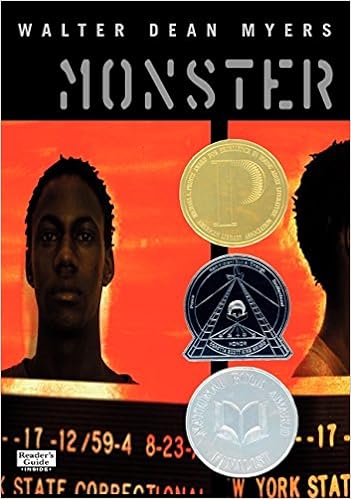
Monster by Walter Dean Myers


Bibliographic Information
Publisher: HarperCollins
Publication year: 1999
ISBN: 978-0064407311

Reader’s Annotation

Steve Harmon is sixteen years old, accused of murder, and dealing with it by writing a screenplay about his experiences in prison and at his trial.

Plot Summary

Steve Harmon is sixteen years old and one of four people on trial for robbery and murder in a convenience store. Remembering his time in his high school’s film club, Steve decides to document everything happening to him in the form of a screenplay. Over the course of the trial Steve listens to the prosecutor call him a monster as the events of the crime are explained in harrowing detail. Steve flashes back to his parents’ reaction to his arrest and his dad visiting him in jail, all the while reflecting on how his decision to get involved with the scheme to rob the liquor store has changed the trajectory of his life.

Critical Evaluation

Monster is written in the format of a screenplay from the main character’s perspective, complete with movement commentary and camera directions. The only deviations from this are short journal entries that seem to occur when Steve cannot process his surroundings in the form of his screenplay and has to get his thoughts out as quickly as possible, in any form he can. By formatting the novel in such a way, Myers places the reader directly into Steve’s head as well as his environment. This is an especially effective device because of the situation in which Steve finds himself: on trial for murder because he made the decision to trust some untrustworthy people. In a way, this element makes Monster a cautionary tale; warning its young readers to think twice before agreeing to be an accessory to a crime.

Author Information
“I was born on a Thursday, the 12th of August, 1937, in Martinsburg, West Virginia. My name at birth was Walter Milton Myers. I was about two years old when my mother died and then I was inexplicably given to Florence and Herbert Dean. I was raised in Harlem by Herbert, who was African-American and Florence, who was German and Native American and wonderful. They loved me very much and I grew to love Harlem.

As a child, my life revolved around my neighborhood and church. The neighborhood protected me and the church guided me. I resisted as much as I could. I was smart (all kids are smart) but didn’t do that well in school. I had a speech impediment and often found myself leading with my fists when teased.

I found solace in books. My mother read to me from a very young age. From my comfortable perch on her lap, I would watch as she moved her finger slowly across the page and I’d imagine the characters. Reading pushed me to discover worlds beyond my landscape, especially during dark times when my uncle was murdered and my family became dysfunctional with alcohol and grief.

I wrote well in high school and an English teacher (bless her!) recognized this and advised me to keep on writing no matter what happened to me. “It’s what you do,” she said. I ended up dropping out of high school (although now Stuyvesant High claims me as a graduate) and joined the army on my 17th birthday.

After the army, I was struggling through life—holding on just enough to survive. Remembering my high school teacher’s words, I began writing at night. I wrote short columns for a local tabloid and stories for men’s magazines.

A turning point for me was the discovery of a short story by James Baldwin about the black urban experience. It gave me permission to write about my own experiences. Somehow I always go back to the most turbulent periods of my own life. I write books for the troubled boy I once was, and for the boy who lives within me still. It’s what I do.”

Source: http://walterdeanmyers.net/about/

Genre
Drama
Fiction

Curriculum Ties
Creative Writing
Language Arts
Social Studies

Booktalking Ideas
Ask the audience to think back to one of the worst things that has happened to them, and how they dealt with it. Were they able to deal with it at all? Explain that being on trial for murder is traumatic for Monster’s sixteen-year-old protagonist, and he copes by writing a movie script about everything that happens. Read the passage where the prosecutor calls him a monster. Then give a rating from 1-5 and tell the audience why this is my rating, and take questions.

Reading Level/Interest Age
School Library Journal: Grade 7 up

Challenging Issues
Language
Murder
PTSD
Racial Issues and Stereotypes
Violence

Preparing for Potential Challenges
http://jeselynsminiyacollection.blogspot.com/p/preparing-for-potential-challenges.html
http://jeselynsminiyacollection.blogspot.com/p/preparing-for-specific-challenges.html
http://jeselynsminiyacollection.blogspot.com/p/preparing-for-specific-challenges_6.html

Why the Item Was Chosen
Although Monster was chosen as the first recipient of the ALA’s Michael L. Printz teen literature award in 2000, it is sometimes left out of lists of important young adult literature. The compelling characters and timeless story make it a valuable part of any collection, especially where young readers are involved. Myers’ choice to format the book as a screenplay written by the protagonist sets it apart from others in the genre, and immediately hooks the reader. Even though it is older than some of the other books I have chosen, I included it in my collection because I feel it will be appealing to young readers, even if they have never heard of it before.

Nineteen Minutes by Jodi Picoult (Audiobook)


Bibliographic Information
Publisher: Recorded Books
Publication year: 2007 (Original book publication 2007)
Run Time: 21 hours 10 minutes
Narrator: Carol Monda

Reader’s Annotation
When Peter Houten opens fire on his own high school, killing ten people and wounding nineteen others within only nineteen minutes, the town of Sterling, NH is rocked to its core. But as the details of the convoluted case unfold, those involved find out that a situation can’t always be explained by surface details.

Plot Summary
Peter Houten has been bullied by his classmates every day since kindergarten. Quiet, weak, and an average student, Peter would rather spend his time writing his own video game codes than trying to be popular. However, eventually he becomes fed up with his daily torment and brings stolen guns and homemade bombs to school. Peter opens fire on his classmates, killing ten and wounding nineteen others. Caught in the crossfire is Josie, who used to be friends with Peter but abandoned him in middle school in favor of the popular crowd. Josie survives the attack but cannot remember anything that happened. She is devastated to find out her steady boyfriend, Matt, was one of the victims of Peter’s attack. When Peter goes on trial for his crimes, Josie attempts to reconcile her feelings about the shooting and remember what role, if any, she had in Peter’s decision to commit such a heinous crime.

Critical Evaluation
Picoult expertly examines every side of the story in Nineteen Minutes. Along with the shooter, many victims, and parents, she presents chapters from the points of view of Peter’s defense lawyer and police investigators. Picoult’s masterful transitions between narrators support the underlying concept that a mass shooting is deeply experienced by everyone in a community in a unique way. Peter’s mother experiences a form of grief even though her child is still alive, albeit in police custody. Peter himself maintains he did nothing wrong and was merely defending himself against years of abuse from his classmates. Josie spends the majority of the novel unable to remember the events of the shooting, but does her best to come to terms with the incident while simultaneously dealing with the death of her boyfriend, a casualty to the crime. Each character drives the novel in a unique way, which is what keeps the reader captivated until the last page. Perhaps most compelling about the audio version of the novel is the single narrator capturing the emotions and intentions of such a large ensemble of characters. The expression in Monda's voice changes slightly for each perspective from which the story is told. This is the mark of a talented storyteller, and a feature of the audiobook that will interest listeners.

Author Information
Jodi Picoult, 48, is the bestselling author of twenty-three novels: Songs of the Humpback Whale (1992), Harvesting the Heart (1994), Picture Perfect (1995), Mercy (1996), The Pact (1998), Keeping Faith (1999), Plain Truth (2000), Salem Falls (2001), Perfect Match (2002), Second Glance (2003), My Sister's Keeper (2004), Vanishing Acts (2005), The Tenth Circle (2006), Nineteen Minutes (2007), Change of Heart (2008), Handle With Care (2009), House Rules (2010), and Sing You Home (2011), Lone Wolf (2012), The Storyteller (2013), Leaving Time (2014) and the YA novels Between The Lines (2012), and Off The Page (2015), co-written with her daughter Samantha van Leer. Her last eight novels have debuted at number one on the New York Times bestseller list. Her highly anticipated novel-in-progress, Small Great Things, will be released this fall as follows: October 11, 2016 (US/Canada), October 12, 2016 (Australia), and November 22, 2016 (UK).

Picoult studied creative writing with Mary Morris at Princeton, and had two short stories published in Seventeen magazine while still a student. Realism - and a profound desire to be able to pay the rent - led Picoult to a series of different jobs following her graduation: as a technical writer for a Wall Street brokerage firm, as a copywriter at an ad agency, as an editor at a textbook publisher, and as an 8th grade English teacher - before entering Harvard to pursue a master’s in education. She married Tim Van Leer, whom she had known at Princeton, and it was while she was pregnant with her first child that she wrote her first novel, Songs of the Humpback Whale.

She wrote five issues of the Wonder Woman comic book series for DC Comics. Her books are translated into thirty four languages in thirty five countries. Four – The Pact, Plain Truth, The Tenth Circle, and Salem Falls - have been made into television movies. My Sister’s Keeper was a big-screen released from New Line Cinema, with Nick Cassavetes directing and Cameron Diaz starring, which is now available in DVD. She received an honorary Doctor of Letters degree from Dartmouth College in 2010 and another from the University of New Haven in 2012.

Jodi serves on the advisory board of VIDA: Women in Literary Arts, a research-driven organization whose goal is to increase critical attention to contemporary women’s writing and to foster transparency around gender and racial equality issues in contemporary literary culture. She is part of the Writer’s Council for the National Writing Project, which recognizes the universality of writing as a communicative tool and helps teachers enhance student writing, and is a spokesperson for Positive Tracks/Children’s Hospital at Dartmouth, which supports youth-led charity fundraising through athletics. She is on the advisory committee of the New Hampshire Coalition Against the Death Penalty. She is also is the founder and executive producer of the Trumbull Hall Troupe, a New Hampshire-based teen theater group that performs original musicals to raise money for local charities; to date their contributions have exceeded $120K. She and her husband Tim and their three children live in Hanover, New Hampshire with two Springer spaniels, two rescue puppies, two donkeys, two geese, ten chickens, a smattering of ducks, and the occasional Holstein.

Source: http://jodipicoult.com/JodiPicoult.html

Genre
Fiction

Curriculum Ties
School Safety

Booktalking Ideas
Talk about the realities of gun violence and mass shootings in the country, including why some people feel it is their only option. Talk about Peter being bullied and experiencing PTSD from repeat attacks, and let the audience think about whether his reaction to repeated bullying was justified. Read a passage describing the aftermath of the shooting at the scene of the crime. Then give a rating from 1-5 and tell the audience why this is my rating, and take questions.

Reading Level/Interest Age
Barnes and Noble: Age 14-18
School Library Journal: High School/Adult

Challenging Issues
Bullying
Death of a Loved One
Depression
Language
LGBTQ+
Mental Illness
Murder
PTSD
Sexual Content and/or Nudity
Teen Pregnancy
Violence

Preparing for Potential Challenges
http://jeselynsminiyacollection.blogspot.com/p/preparing-for-potential-challenges.html
http://jeselynsminiyacollection.blogspot.com/p/preparing-for-specific-challenges-lgbtq.html

Why the Item Was Chosen
I included Nineteen Minutes in my collection because Picoult uses it to communicate the dangers of bullying, as well as the fact that there are usually multiple sides to a story. These are concepts crucial to adolescent development as well as life in high school, and Picoult takes her time explaining them from the perspectives of several characters in order to drive the points home. Many young adults do not realize the ramifications of their actions toward others. An action that seems harmless to one person could send another person’s psyche into a tailspin. Listening to Nineteen Minutes might compel teen readers to take a closer look at their own actions and the actions of their peers, and speak up if they see a potential problem before a horrific event like the one Picoult illustrates has a chance to happen in their own school.

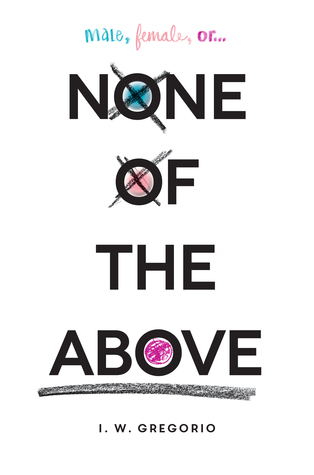
None of the Above by I. W. Gregorio


Bibliographic Information
Publisher: Balzer + Bray
Publication year: 2015
ISBN: 978-0062335319

Reader’s Annotation
Kristin loves her life as homecoming queen, track star, and girlfriend to Sam, one of the most desired guys in school. But when she and Sam try to take the next step in their relationship with painful results, a visit to the doctor reveals something Kristin never suspected about her own body.

Plot Summary
Kristin Lattimer considers her life normal in every way. She has a steady boyfriend she’s crazy about, a passion for hurdles in track and field, great friends, and a place on her school’s homecoming court. She even thinks she and her boyfriend Sam might be ready to take that next step in their relationship. When the time finally comes, she experiences so much pain she knows something must be wrong. A visit to the doctor reveals that she is intersex, meaning that although she looks and feels female, she has male chromosomes and internal testicles. Following her diagnosis, she confides in her best friend and the news travels the whole school in just a few days. Sam, disgusted and uninterested in the truth, listens to ugly rumors and abandons her. With the help of a new friend from an online support group Kristin learns how to live with her diagnosis while preserving and enjoying her femininity.

Critical Evaluation
Gregorio used her medical knowledge expertly in the crafting of this novel. The medical facts of being intersex are explained on a level that all readers are able to understand, because Kristin has no knowledge of the condition. At times, Kristina’s character feels very wrapped up in what is means to be a boy or a girl, but the frequent reminder that the medical condition usually shows no outward signs is a reminder for the reader that she had no warning whatsoever; she suddenly feels that with this new information about her body, her life for the past 17 years has been a skewed reality. From the doctor explaining all the different forms being intersex can take in different people, to the information Kristina gains in online support groups and forums about maintaining her identity as a female even though she has “male” hormones, Gregorio presents the information in an accessible way that never feels too clinical.

Author Information
I. W. Gregorio is a practicing surgeon by day, masked avenging YA writer by night. After getting her MD, she did her residency at Stanford, where she met the intersex patient who inspired her debut novel, None of the Above (Balzer + Bray / HarperCollins), which is finalist for the 2016 Lambda Literary Award, a Spring 2015 Publishers Weekly Flying Start, an ALA Booklist Top Ten Sports Book for Youth, and a 2015 ABC Children’s Group Best Book for Young Readers. It was also named to the 2016 American Library Association Rainbow List and is under development as a TV series by Lifetime. She is a founding member of We Need Diverse Books™ and its former VP of Development. Her writing has appeared in The Washington Post, San Francisco Chronicle, San Jose Mercury News and Journal of General Internal Medicine. A recovering ice hockey player, she lives in Pennsylvania with her husband and two children.

Source: http://www.iwgregorio.com/about/
Genre
Fiction

Curriculum Ties
Health
Science

Booktalking Ideas
Briefly explain what it means to be intersex, and talk about how Kristin still identifies as female even though she has male chromosomes and “parts” inside. Read a passage detailing the ugly rumors circulating her school to emphasize that her friends used the information she confided incorrectly. Then give a rating from 1-5 and tell the audience why this is my rating, and take questions.

Reading Level/Interest Age
School Library Journal: Grade 9 up

Challenging Issues

Bullying
Language
LGBTQ+
Sexual Content and/or Nudity

Preparing for Potential Challenges
http://jeselynsminiyacollection.blogspot.com/p/preparing-for-potential-challenges.html
http://jeselynsminiyacollection.blogspot.com/p/preparing-for-specific-challenges-lgbtq.html

Why the Item Was Chosen
I included this book in my collection for several reasons. First, many of the books are ones I myself loved when I was an adolescent reader growing up in the 1990’s and early 2000’s. I stand by these choices as legitimate material for modern young adults, but it is also important to remember that current teens want to read current material. From the modern approach to intersexuality to the cyberbullying Kristin experiences at the hands of her ex-friends, None of the Above presents issues to which today’s teens will be able to relate. Second, intersexuality in all its forms is still swept under the rug or only briefly glossed over in a lot of sex education. Using this book as a conversation starter about what it means to be intersex, or have chromosomes that differ from the gender with which one identifies, could be invaluable in preventing an identity crisis like what Kristin experiences. Finally, representation in young adult literature is endlessly important. Being intersex is not common, but diagnoses do happen and the diagnosed often have no support system to fall back on. The library is a place where teens can gather information in a judgement-free environment. If a young adult patron experiences an unexpected diagnosis like Kristin does, I want them to be able to find at least one book in my collection that will let them know they are not alone.

Oblivion by Sasha Dawn


Bibliographic Information
Publisher: Egmont USA
Publication year: 2014
ISBN: 978-1606845707

Reader’s Annotation
Following a traumatic incident she cannot remember, Callie is afflicted with graphomania, the intense compulsion to write. In order to cure her psychological condition she has to find her missing father and the girl he kidnapped one year ago.

Plot Summary
A year ago, Callie was found in an abandoned apartment writing endlessly on the walls. Following a traumatic incident she cannot remember, Callie has developed graphomania. Her condition forces her to write the words spilling from her head anytime, anywhere, on anything including her own skin. In order to get better, Callie has to find her missing father and Hannah, the girl he seems to have kidnapped on the same night Callie was found. With the help of her foster sister and sometimes-boyfriend, Callie tries to find Hannah and quiet the words in her head bursting to escape.

Critical Evaluation
Dawn’s novel is set apart from other young adult novels because of her realistic representation of mental illness. Graphomania is not a widely known and understood disease, so Dawn is forced to explain the compulsion in depth while not deviating from the story told from Callie’s troubled point of view. Using the character of John to explain Callie’s compulsion in depth to someone who has never heard of it is a useful device, if not a new expositional technique. The story arc vacillates between moving quickly and dragging. The pace of the story picks up and becomes exciting when Callie has an attack of graphomania, among other times. The pace slows to a crawl at other instances, like scenes between Callie and her foster sister. These scenes are obviously for expositional purposes and pull the reader out of the flow of the story to explain something the author would rather tell than show. Aside from inconsistent pacing, Oblivion effectively draws the reader into Callie’s terrifying mystery.

Author Information
The story begins when I'm seven years old, living in a haunted house. I don't sleep. I'm afraid, and I'm seven. Would YOU risk falling asleep amidst the spirits of the night? One thing I know I shouldn't do is wake Mom. The woman is exhausted all the time. Besides, if I tell her of the hauntings--the whispering, the pulling on my hair, the tickling of my toes--she won't believe me. "Chalk it up to her wild imagination," she'll mumble to my father, who is somewhat of an apparition himself.

My brother, who is about four, walks the hallways at night in a daze, sleepwalking. Sometimes, if I drift off, I wake up to find him staring down at me. It's another reason I don't sleep. He's cute, but creepy. I wonder if the entities in this house influence him to rise out of bed every night.

My sister sprawls on the twin bed on the other side of the room. The spirits don't bother her. I wish they would, and not just because she's somewhat of a nine-year-old tyrant, but because if she experiences it, she'll believe me. She's a good person to have on your side, if you know what I mean.

Tonight, I've already walked my brother back to his room, and I'm trembling beneath the covers when I hear it: "Psst! Sasha! Go into the closet!" They're snickering at me, yanking at my toes. It's nearly 3 a.m. I'm tired, and I want it to stop. I have much to do in second grade tomorrow. So I do the unthinkable. Walk into the closet. Sit on the floor. Wait for something to happen. NOTHING happens. But they're silent at last. When I look up, I see a notebook and a pencil waiting for me on a shelf. I take it down and start to write. I haven't stopped since…

​Source: http://www.sashadawn.com/

Genre
Fiction
Mystery

Curriculum Ties
Psychology

Booktalking Ideas
Speak briefly on compulsions and mental illness, and how these can sometimes come on suddenly in response to trauma, then introduce the character of Callie. Read a passage from the beginning of the book that explains her graphomania to get the audience curious about her condition and the mystery that the story follows. Then give a rating from 1-5 and tell the audience why this is my rating, and take questions.

Reading Level/Interest Age

Booklist: Grades 9-12
School Library Journal: Grade 10 and up

Challenging Issues
Depression
Language
Mental Illness
Running Away
Self-Injury
Sexual Content and/or Nudity

Preparing for Potential Challenges
http://jeselynsminiyacollection.blogspot.com/p/preparing-for-potential-challenges.html

Why the Item Was Chosen
I came across this book by accident at the bookstore two years ago. I was drawn in by the cover image of a girl’s face covered with red, handwritten words. After reading the cryptic synopsis on the back, I was hooked and had to buy it. I believe the young adult patrons in my library will be equally drawn in by these things and it would be checked out and read often. Popular books with well-known authors yield a large number of readers, but so do unknowns when they are exciting, riveting, and promoted correctly. If this book were displayed prominently in the young adult section of a library, it would be circulated often and enjoyed by many teenage patrons. I have included it in my collection because although Dawn is not a popular author like John Green and Oblivion is not as ubiquitous as some young adult titles, I think it has the potential to be in high demand in my library.